Thursday, July 4, 2013

GARDEN WORKHORSE

'Soleil d'Or' hybrid tea rose.

   
     My grandmother never would have thought of a rose as a "garden workhorse." Roses were the prima donna's of the garden -- beautiful, but temperamental and demanding. Gardeners of that generation were constantly spraying and dusting and mulching and worrying about hideous-sounding diseases like "black-spot." Rose gardeners seemed only one step below orchid growers when it came to obsessive pampering and slavish devotion.

     In the last two decades nurseries and botanic gardens have made determined strides toward breeding rose cultivars more suitable for lazy gardeners like me. The new varieties are frequently patented or trademarked and you will see names like "Carefree" and "Flower Carpet" on many pot labels.

     The most recent and popular of these are the 'Knock Out' roses. These roses are cold hardy and have much better disease and insect resistance than traditional roses. I prune mine once a year around the first of March and I give them water when they need it. Otherwise I leave them alone. My wife Wan "dead-heads" (that is, cuts off spent blooms) periodically. This encourages more new blooms, but it is not essential. Knock Outs require significant, but not full sun.


The Knock Out patch at my front steps.

    For this relatively puny effort, my Knock Outs keep blooming from May until after Thanksgiving. When you compare this to the 2-3 weeks peonies are in their glory, you can see why I call them "work horses." It is hard to get more bang for the buck.


     When they first came out, the only problem with these beauties was that they came in only one color -- a kind of dark neon pink. With each passing year, however, more varieties appear. There are now double-blooms, pinks, light pinks, yellow/creams, and coral blooms with yellow centers. Now we can be lazy and picky at the same time.

Wednesday, June 12, 2013

LOVE, HATE, AND PEONIES


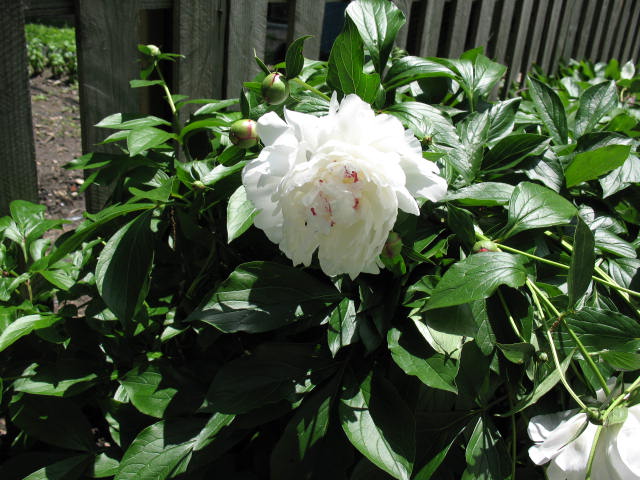
     While my back was turned we somehow ended up in the middle of peony season. Now I am in a rush to celebrate before the show is all over. Peonies are indeed some of nature's most gorgeous flowers. Their size and vibrant colors can be almost overwhelming. As cut flowers they can add fragrance to our homes in addition to visual beauty.

     But while their beauty makes us gasp, they can also make us gnash our teeth in despair. Their sins are notorious: 


     They flop -- and it is hard to admire a beauty who insists on staring at the ground.

     Second, we are not their only lovers.
Ants, too, find them irresistible. Woe to any who fail to inspect their blossoms before bringing them indoors.


     But worst of all, their lives are fleeting. We are lucky to experience more than two weeks of glory before the display is over. Sometimes not even that if a good thunderstorm comes along at the right time.

     In short, the life of a peony-lover is at best bitter-sweet.


     Nothing can make  a peony what it is not, but there are a few steps we can take to ease the pain.

     I keep the ants at bay with a combination of boiling water and cayenne pepper. 


     There are also a large variety of hoops and cages dedicated to fighting flops. My answer to this problem, however, is different. I am a passionate advocate for the tree peony (Paeonia suffruticosa). This shrub form of the peony has a woody stem that simply will not flop. Tree peonies are expensive and sometimes have to mature two to three years before producing their first bloom. But once they flower there is not a more spectacular bloom on the planet.

Paeonia suffruticosa


     Finally, for those of you who are really obsessed, it is possible to more than double your peony season by researching carefully. Different varieties of peony bloom at somewhat different times, so if you pick your cultivars well you can end up with a rolling cascade of flowers that lasts several weeks.

Thursday, June 6, 2013

TWO POND VARIATIONS


Note marsh grasses and water lilies growing in this pool.


     Back in March I wrote a bit about ponds in the home landscape. Today I thought I would mention two recent permutations on the modern pond. The first began in Austria and has spread through Europe and reached Canada and the West coast of the US. This is the environmentally correct natural swimming pool. No chlorine and other chemicals here. Instead, the pool uses a more elaborate variation of the system of physical and biological filters used by the fish ponds I described earlier. Pumps keep the water aerated and move it over and through gravel colonized by beneficial bacteria as well as through the roots of water plants that absorb nutrients that would otherwise turn to waste.

     In addition to private pools like that shown above, Europe sports large public pools that service hundreds of swimmers at a time -- all without chemicals. A similar public pool is scheduled to open in the Twin Cities next summer.

     At the other end of the spectrum is a water feature designed for those who prefer less "biology." You can have the sights and sounds of running water and a completely landscaped falls and stream without a body of standing water. Instead of a pond, the stream feeds into a mass of river pebbles and sinks out of sight. Beneath the pebbles lies a hidden reservoir and a pump that recirculates the water.

This sketch shows the secret of a "pondless" waterfall.

          I personally would never give up the joys of having fish and a full ecosystem (in which, by the way, fish eat mosquito eggs). But for those who want the sights and sounds of water without worrying about the health of other creatures, a pondless waterfall may be just the ticket.


This long stream vanishes into the rocks at the bottom of the hill.

Friday, May 24, 2013

HARVEST IN MAY


         Here we are a month later and it is still cold and rainy. While this spring has been less than thrilling for us, our plants have liked it. Most of the shrubs and perennials I see seem to be thriving.

     Wan and I (actually, more Wan than I) planted our warm weather veggies (tomatoes, cukes, peppers, beans, etc) on Tuesday. On the same day we began to harvest. You will recall that we were able to get many of our cool weather crops in the ground around the first of April. As a result of this early start we are already eating the results.Our heads of broccoli are already larger than my fist, and one of them made it into a pasta sauce this week. We have also pulled radishes and rapini.
Sugar snack peas.

     Plants grown from seed always come up too densely and the books always tell you to thin them. This was a chore I always tried to avoid before I realized that thinning seedlings could become an early harvest. Now I "thin" my spinach and other leafy greens directly into my salad bowl or soup pot. The tiny greens are tender and delicious. At the store you pay extra for baby spinach, after all. Here it is free and you help your other plants grow at the same time. What could be better?


Friday, April 19, 2013

And Again: "Spring?"


    A month ago I was complaining about how cold March was. Now it is a month later and everything seems exactly the same. True, the crocuses and then daffodils finally made it up. I can even see a few tiny tulips. And the grass is a bit greener, though much of the forsythia is just now starting to pop.


     Still, one has to pay attention to notice the changes from a month ago. Many of the tasks I laid out for us last month can also still be done today. This is probably a good thing, since the cold kept many of us indoors in any case.

     One exception is bed preparation. A month ago I mentioned how you can tell if your soil is dry enough to till your flower and vegetable beds. As luck would have it, my neighbors had a new clean-out installed in their drain that involved digging a big hole in the middle of their yard. I wandered over, grabbed some dirt from the pile and discovered that it was the perfect consistency for tilling.


Post flood beds-- a bit lumpy but unbowed


     Thanks to this sheer accident I was able to till my beds during the last week of March -- mixing all the compost I had added from my drum into the bed last fall. My wife Wan and I have fun in the winter devising a new, revised map for our garden based on our experience from the year before. In March we were ready to bring the map outdoors and build our raised beds within the 22'x 28' veggie patch.


Early broccoli and Brussels sprouts


     Given that our springs are frequently cold and wet, I like to use raised beds. Raising them gives the new seedlings better drainage and allows the soil around them to warm up more quickly. Beds that are higher than the pathways also helps provide a "no feet allowed" zone to keep plant roots happy. I usually make my beds three feet wide and leave a full two feet for pathways. It is always a good idea to provide walkways big enough to keep the gardener happy as well as the plants. I cover the plants with re-usable landscape cloth and use the extra to cover the beds where things like tomatoes will go later.

     By April first I had planted snow and sugar snap peas, rapini, romaine, radishes, parsley, chard, and spinach in addition to the broccoli and friends. Most of these survived the recent flood. Any casualties will turn out to be seeds that can easily be replaced.

     Those of you who did not jump when you had a chance will now have to wait 40 days and 40 nights for the floods to recede. Well,... maybe not quite that long.


Friday, March 29, 2013


Waterfall and pond at my old house.


     While we are waiting for better weather it can be fun to look at various elements that can be added to our yards. An increasingly popular element is the natural pond. Today's ponds are a far cry from the old concrete and stone ponds of our grandparents day -- the ones that seemed to crack at least once a year and let all the water leak out.

     Today's ponds are lined with a non-toxic and flexible liner, are run with very efficient recirculating pumps, and contain both physical and biological filters to keep the water clear.
 
     A pump in the bottom of the buried container on the left pumps water up into the bottom of the waterfall container on the right. The water spills over and down a rocky slope picking up oxygen before filling the main pond basin. The pump pulls water only from the pond's surface, pulling leaves and other debris along to be caught in a net inside the pump box.

     A system like this allowed me to keep a separate little ecosystem going for 20 years now. Over 20 fish have lived among the flowering waterlilies and other plants. The sound of the waterfall combined with the colorful flashes from the darting fish were mesmerizing and worked to smooth a furrowed brow many a time.

     The maintenance chores required to keep this system going were less than that required by a lawn. Once a year you have to do a serious clean-up. This is a wet and muddy job, but you can always hire someone like me to do it for you.

     Pond plants, like other perennials, need to be trimmed and deadheaded once or twice a season. The rest of the year you have to "top off" the pond when it gets low and make periodic adjustments to keep the pond ecology in balance. For those who find turning on a garden hose straining, an automatic filling system can be added.

     In short, despite appearances, having a pond is something that works even for lazy people like me.
     

Sunday, March 17, 2013

SPRING?


     We actually had a mild winter in 2013. Despite, for example, the fact that we had next to no snow most of the season we were able to make up a bit for last summer's drought. This is because most of our precipitation was rain.

     Those balmy days are now forgotten as we stay locked in a deep freeze for the entire month of March so far. Our average temperature this month  has been a full six degrees below normal. Quite a change from the 80 degree days of last year.

     If you can stand the cold there is actually a lot you can accomplish this time of year:

     Now is a great time to do a yard clean-up before bulbs and perennials start getting in your way. If you use an organic weed-killer, now is the time to make sure you have some on hand. You want the weedkiller to go down once the crocuses come up in order to beat the first weed seeds trying to germinate. I noticed my first crocus today.

     Now is also the time to begin pruning your trees and shrubs -- especially if you want to downsize them significantly. You do not, however want to prune shrubs like forsythia and lilacs that bloom in spring. You would be cutting  off their buds. For much more on pruning you can look back at some of my entries from last season at this time.

     I am already yearning for fresh garden vegetables. We are months away from the favorites like tomatoes and peppers. But cool weather crops like peas, spinach, and many other leafy greens, are closer than you think. As of St. Patrick's Day, the barrier to planting seeds for these plants is not temperature so much as soil moisture. Our ground is still water-logged, and messing with it now will damage it. To test, dig a hole about six inches deep, grab a handful of soil and squeeze it into  a ball. If it makes a good mud ball, the soil is still too wet. If it wants to fall apart, you are in good shape.