Sunday, October 19, 2014

COMPETITION!


     While my crew was planting shrubs in a client's back yard, a crew of interlopers showed up to install their own landscape  plan in the front. Imagine my dismay!


     Using a unique business plan, these landscape pirates did not charge for installing their plan. Instead, they demanded a "donation" to remove their work, and you get to pick the next victim.

     The rapscallions responsible turned out  to be kids from the Beverly Unitarian Church on a fund drive. My attorney cautioned me against a lawsuit. He told  me this meant issues of church and state and I would  probably be in litigation for 10 years or more. He advised me to do nothing -- and to avoid mentioning my address.

     I wish them luck -- in yards other than my own.


Sunday, October 12, 2014

BULB TIME

Early Crocus

     Now is the time to buy and plant spring-flowering bulbs. There are thousands of bulbs blooming at all times of the year. I am referring to the ones we know best -- those  hardy bulbs that need a dormant period in cold weather to prepare for flowering.

     Bulbs can provide some of the earliest signs of  spring. After an endless and dreary February, there is nothing more heartening than the the first appearance of a snowdrop or crocus -- even when it is popping out of the snow.

     For  many, "bulb" conjures up an image of tulips. Tulips have been called  "the king of flowers," and they are  spectacular. But they are not necessarily the best pick for home gardeners. For one thing, squirrels love tulip bulbs. Many a tulip bed  I have known was lovingly planted only to disappear overnight. Some of us over-lay the beds with staked-down mesh and then take it up in the spring. This can be effective but can also be a lot of extra work.

Gorgeous, but a lot of work.

     Tulips demand regular fertilization and even then tend to become  less productive over time until they stop flowering altogether. Many large institutions that plant tulip beds have given up on maintaining them and simply treat  them as annuals, planting anew  every fall.

     I prefer the bulb that requires as little of my labor as possible. Most of my favorites "naturalize," meaning they survive and reproduce naturally without any effort on my part. Plant them once and you are done.

Galanthus

     The first bulbs to appear around here are Galanthus, or Snowdrops. Every spring these stubborn little  plants pop up early, get  buried in snow,  and then pop  up again. A real morale booster.

     They are  followed  by Crocus and Scilla in April. Like Galanthus, they "naturalize" and the small size of the leaves allows  them to be planted directly in the lawn. Their flowers are done by the time you need to get  out your mower. And if you mow  as high  as you should anyway, there will be enough leaf left  to restore the bulb.


Crocus sieberiTricolor

That haunting blue color up and down Longwood
 in spring comes  from naturalized Scilla. 

     Also blooming in April are naturalizers Muscari (or Grape Hyacinth) and Narcissus. These grow too tall for the lawn but do wonders in beds or other un-cut areas of the yard.  Narcissus come in a variety of names, including "Daffodils" and "Jonquils," and many different sizes and shapes. They give you a thousand varieties of white and yellow blossoms.

Muscari aucheri


    Bulbs are best purchased from mail order companies that specialize in bulbs. The time to order is about now. You will  still  get your bulbs in time to plant them. Don't be bashful. Indoors, a single flower  can make a statement on your dining table. Outdoors the same flower is utterly lost and beneath notice. Don't even think about buying less than 100 bulbs.

     Follow the instructions that come with your order as to depth and spacing. The soil temperature should be below 55 degrees but above 32 -- refrigerator temperature. Bulbs like well drained soil with a neutral PH. If you need to, you can do a little soil preparation while your bulbs are in the tender clutches of UPS.

Narcissus mix

     When you plant do not add fertilizer, but do water thoroughly.  After the ground surface freezes you can add a layer  of mulch.

     Finally, keep in mind that after the flowers are spent next spring, larger bulbs will leave a tangle of unsightly foliage. Resist the temptation to cut this down. The leaves collect the sun's energy to restock the bulb for next year's bloom. It is best to plan your bulb patch  to be just behind some perennials. The perennials will be barely visible when the bulbs are in their glory, but will grow to screen the scraggly foliage once the flowers are gone.


Saturday, October 4, 2014

October Planting


     The first leaves began to fall last week and we had about a week to enjoy them before our first rain. Heavily wooded Beverly is a lovely Chicago neighborhood in fall, and I try to find time to walk about in it watching the leaves change one species at a time. This is a time when delayed gratification does not work. If you wait, it will  rain again, so enjoy today's leaves before you worry about disposing of yesterday's.

     While everyone knows about clean-up in autumn, surprisingly few take advantage of the season to plant. Fall is actually a better time to plant trees, shrubs, and perennials than is spring. The soil is warmer in the first part of autumn than it is in April, and as the top of the plant begins to go dormant, its energy can focus on its roots. Seasonal rains and lower temperatures also assure the new plant of a decent water supply. Spring plantings, in contrast, try to put on shoot and leaf growth before roots have had a chance to get going. The plant can easily confront hot temperatures  and dry weather before its roots are established.

     The only real disadvantage of autumn is that nurseries let their stock dwindle away. They don't want to have to over-winter their excess stock. So choices tend to  be more  limited while prices tend to drop.


     My rule of thumb is that you can plant perennials as long as you can recognize what is in the pot, and you can plant trees and shrubs as long as you can get your shovel in the ground. In this case, delayed gratification is definitely the right course to take.

     If Autumn is a good time to plant shrubs and perennials, it is the essential time to plant spring-flowering bulbs. They have to go through a dormant period before they can flower. That means they have to be planted just before winter arrives. And that means you should order and plant 2015's bulbs in the next month. More on this next time.

Crocus bulbs


Wednesday, September 24, 2014

Fall is Here


     The fall equinox arrived a little after 9 PM Monday night -- and our weather began to improve.

     The summer of 2014 was the wettest on record in Chicago and one of the coolest. The temperature broke 90 degrees all of three times this summer, as opposed to an average of 17 times and a whopping 40 times just two years ago.

     Beach goers gave the season a big thumbs down, but I loved it. Lots of good working weather and a little  relief from all those bills for air conditioning and watering.

     Reactions also  vary among my plants. The cukes are starting to lose steam already, and both the yield  and the size of my tomatoes are smaller than usual. Their taste is as good as ever, however.


One  of our  beans hiding in the  vine.

     The Romano pole beans took a while to get going,  but they have been both productive and delicious for more  than a month. And our hot  peppers surprised us.  They have been producing faster than we can harvest them.


Lemon Grass  is flanked by a Tobasco pepper.

     We tried two new additions to the garden this year. Lemon grass is a  Southeast Asian herb that is a delicious addition to soups and other hot dishes. The second was fingerling potatoes. We tried these because they are so expensive in stores. They turned our to be easy to plant, quick to harvest, and delicious!


Fall sugar snack  peas.

     The fall crop of snow and sugar snack  peas we planted at the end of July have begun to produce pods now. Southern gardeners do this double-cropping all  the time, but I always feel like I am getting away with something when I harvest  a  fall crop right before a frost in Chicago.

     We can do more than harvest, though. September and October are also a great time to plant.  More on that next time.


Coral Bells awaiting fall planting.

Wednesday, September 10, 2014

More Late Bloomers

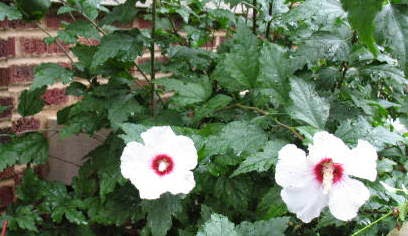
Hibiscus syriacus

     As we pass from summer into Autumn, we can also move from our Bottlebrush Buckeye to the hibiscus family, who tend to bloom from late summer until first frost. The hibiscus family contains under one roof a confusing variety of plants and an even greater variety of names. It's members range from 12 foot woody shrubs to knee-high perennials and have many aliases: Althea, Mallow, Rose  Mallow, Swamp Rose and Rose of Sharon.


     The largest of these, Hibiscus syriacus, is usually known as Rose of Sharon or Althea. Once thought of as old fashioned, Rose  of Sharon are actually appropriate for many houses in our area of Chicago and have experienced a revival in popularity. Although they can get to be 12 feet tall, they bloom on new wood, so you can prune them ferociously in late winter and  still have a substantial and floriferous shrub by summer.


Texas Star Hibiscus


     The other cultivars of hibiscus are far less common  in Chicago yards and we are missing out. Ranging from three to seven feet tall, many die down to the ground every winter. In their prime they produce huge disks in vibrant colors that  can give our yards a tropical flavor.


Hibiscus moscheutos

A PS on the Bottlebrush Buckeye:  The owner of the shrub in my last posting pointed out that his Buckeye also  attracts exotic butterflies. Yet another virtue possessed  by one of my favorite plants.

Sunday, August 24, 2014

AESCULUS PARVIFLORA

Aesculus to the right.
     Periodically I make an effort to encourage biodiversity by highlighting an underused native plant. Since native plants seldom get the respect they deserve, I gussied this one up with its Latin title. "Aesculus"  even sounds vaguely like  the ancient Greek playwright. Much more elegant than "bottlebrush buckeye." Or how about horse chestnut? Or the British "conkers?"

    An impressive and elegant plant, the bottlebrush buckeye can get 8 feet high and wide in Chicago.  Generally a slow grower, it also produces new shoots from the ground that can grow a few feet in a single year. If you like the location of a shoot, let it grow. If you don't, cut it off at the ground. No rush. This is a very low maintenance plant. No serious diseases or insect problems; adapts to different soils; at home in both sun and shade. The established stems do not need pruning, but can easily be trimmed to stay at the size you want.

     As an added bonus,  very few weeds try to grow under the canopy of these buckeyes. The reason for this is a mystery, but welcome nonetheless.

These flowers are in the early stage of bloom.

     The leaves and leaf clusters have an almost tropical look. The mid-summer flowers are outstanding, and even the seed capsules are quite striking. (In Chicago fruiting is sparse, so there is almost no mess.) Buckeyes can be used as specimen plants or planted in masses -- under shade trees, for example.


     You are not just doing our native flora a favor when you give a home to this magnificent plant; you are doing yourself a favor as well.
   

Wednesday, August 13, 2014

Year of the Polar Vortex

Chicago Beachwear in July.


     First an apology for my long absence. My clients simply overwhelmed me with work. I could just see the reaction from some of them  to a post from me: "So the guy hasn't found time to do my job yet, but he has time to scribble." First things first.

     Yesterday at 3 PM my thermometer read 61 degrees -- more than 20 degrees lower than the average high for that day. This continues a trend that began with our ferociously cold winter that led to a cold and wet spring. Spring in turn spawned the coldest July on record.

    The coldest July on record sure beats the coldest January on record, and I, for one, was a happy camper -- unlike Chicago beach goers,who had to deal with frigid water temperatures as well as cool air.

     The response of our plants has been mixed. The winter created some real damage this year. Roses had to be trimmed much lower this spring and  many yews  were covered with brown tips from winter dessication. Our insect pests like Japanese beetles, declined in number. But some of the hearty fungal spores enjoyed the wet spring and attacked plants they had left alone previously -- -like my broccoli.

This year's invalid broccoli..

     I had a beautiful patch of basil this year. Just before we planned to harvest half of it to make pesto for the winter, an absurd "polar vortex" blew in and blackened most of our basil leaves-- in July! We had to cut the top  3/4 of each plant and then wait for them to re-grow.

     Fortunately, though, most  plants in the area were just held back a couple of weeks. Most  flowers and veggies are now thriving,  and we have planted seeds for a fall crop in our garden. After three cold seasons in a row, maybe we will get a break this fall.