Saturday, December 19, 2015

A Glorious December


This guy just bloomed. Note the small bud top center.

     What a great month! Usually December crashes down like the blade of a guillotine, leaving behind  frozen hoses and clogged gutters.  This December has so far been as gentle as a kiss. A few colder days, but the average temperature for the first half of the month was 10 degrees above normal. Today we are in our worst cold snap so far, but it is supposed to reach 50 degrees again next week.

     Our Knock-Out Roses are the only bloomers left, but they are still  sputtering along, as you can see, and the Rhododendron are a bright healthy green with large buds that bode well for next spring.

     We ate the last of my pantry-ripened tomatoes on Sunday, and picked the last of our cold weather crops before this last freeze. We pulled the spinach at the beginning of the week and our last shopping bag full of Swiss chard yesterday.

This Swiss chard is now in the fridge awaiting dinner.
     All that is left in the garden is our parsley and a little bit of mint.


     The warm weather also allowed me to get all my garden clean-up chores finished up well before the holidays. I even got the wreath my Mom sent me up on the house before she demanded visual evidence. Now I can concentrate on my eating.


     I wish all of you the best during this holiday season.

Scott

Friday, November 20, 2015

A Fond Farewell to the Vegetable Patch -- Almost

Lonely posts at the back are all  that is left of the cucumber
  vines  that fed me all summer.

     September's warmth continued right into October and then even most of November. Who needs North Carolina  when I can live  like this? We owe this bliss,  apparently,  to  a strong El  Nino in the Pacific.

     I am not complaining. In addition to wearing short sleeves much later than usual, I saw the leaves on my trees change color more leisurely and cling to their branches much longer.

     My veggies did the same. Cukes seem to have a clock of their own no matter what the weather, so they checked out at the end of September. But my green beans and tomatoes were still poking along last week when we pulled the last of them. The beans are safe in the freezer, along with all the basil and pesto sauce. Our last tomatoes are still ripening in a flat cardboard box in the pantry, I had two more at lunch today.

This small head of broccoli should withstand
 what may be our first light frost of the season.

     My fall crops of cool weather veggies like chard, snow peas, spinach and parsley are still going great guns and should even make it through the 4 inches of snow we are supposed to get tomorrow. But we harvested about half of them just to be safe.

My peas lie right on top to make them  easy to pick..
Next year I will train them to jump directly into my bag.

     And my parsley, so essential to everything from pasta to tabbouleh salad, will get frozen and crushed several times by the snow and still spring back when the sun pops  out. I hope to be picking some for Christmas dinner.

Tuesday, November 3, 2015

Falling Leaves


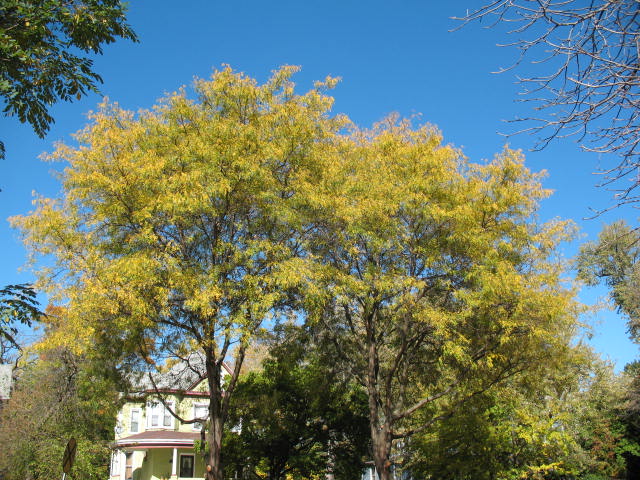
     A remarkably warm September has helped keep the leaves on the trees longer than usual. Not until Halloween weekend did our trees start shedding seriously.


     Some of these leaves serve a crucial fall  function. They act as great pillows to jump and fall in and are a lot of fun for some of us 14 and younger -- and even some of us 65 and older.

     Far too many of us rake and bag all our leaves in a feeble effort to keep our lawns clean. Not only does this create unnecessary work, it adds additional tons of refuse to our landfills and starves our yards of  nutrients.


     I use a leaf blower and a mulching lawn mower. I blow the leaves out of the flower beds into the yard where I can chop them up with the mower. I blow some of the inch or less leaf fragments back into the beds and leave the rest on the lawn.

     For the first several days the yard looks a complete mess, but a few days of breezes will encourage the leaves to shimmy down the blades of grass closer to the earth, and the yard will quickly look much better. Meanwhile, I have saved my self all the aggravation of bagging the leaves up. The leaf bits will decompose over the winter and provide spring fertilizer for the new grass. The decomposition will also produce a leaf mold that inhibits grubs.


     A heavily shaded yard in Beverly may require more frequent mulching than  summer mowing. But there is no raking and no bagging and you get free fertilizer, grub control and even fewer Japanese beetles the following year. So what is not to like?


     By the way, for you procrastinators out there, we are having yet another bout of delicious warm weather, and you still have plenty of time to buy and plant spring bulbs.

Friday, October 9, 2015

Blooms in Early Fall


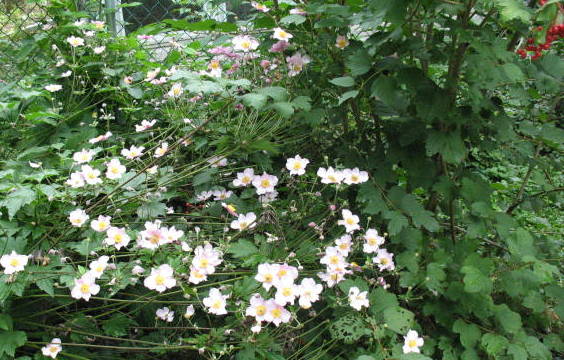
     Labor Day does not end the season in our flower gardens unless we want it to. One example is the Japanese anemone pictured here. My anemones began to bloom in August and,  while largely over now, are still giving me new blossoms today.

     A very large and irrepressible perennial, Japanese anemone can take up a huge amount of real estate. If you don't want to spend a lot of time staking and pruning it, it is best put it toward the back or in another spot where you will  not expect it to be neat and tidy.

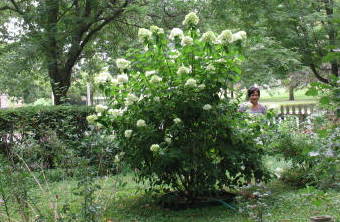
     Other summer/fall plants that shine this time of year are hydrangeas. We adopted this Limelight Hydrangea a few years ago. My Wife Wan is in this photo (under protest) to give  you a sense of scale.


     These Hydrangeas start with a "limelight" cast to them, then turn snowy white, and eventually add some pink tones as well.

     Autumn Clematis is also in its prime in September and is still attractive in October. A client in Hyde Park has  a "ruin" of an old wood play set that has been completely taken over by Clematis (with a little help from us.) I showed a photo of it a couple of years ago on this blog.

     This spring I borrowed a cutting from the Hyde Park plant to start on my front arbor.


     This vine is aggressive, but not difficult to handle. Next year I will have to cut a hole above the walk to allow the mailman in. But you could not ask for a more enticing entry to my front yard.

    The champion of fall bloomers, though, is the Knock-Out Rose. As  long as you snip off the spent flowers it will continue to  produce -- seemingly forever.


     This photo was taken today, and these flowers will continue to look good in mid-November. In a good year some will make it past Thanksgiving.  In Chicago that is indeed something for which to be thankful.

Friday, September 18, 2015

Harvest


Summer Basil with Broccoli Looming Behind


     After a very cold and wet spring that lasted through June, my warm weather crops were really plodding. Leafy vegetables like Swiss Chard and Basil responded quickly to a little hot weather. But my tomatoes, cukes and green beans grew lots of leaves and stalks but refused to flower or fruit through all of July and part of August.Only my chili peppers began to fruit in July

     My cukes relented first toward the end of July. We grow the pickle type that does not need peeling. They had a great August and are just finishing up now. 

Hiding under a Leaf.

     We dug up half our crop of fingerling potatoes in August and just dug the last half up last weekend. These little guys melt in your mouth and are very easy to grow.

     Tomatoes always seem to involve a roll of the dice, and we usually plant about six varieties to increase our chances. August began with only our cherry and grape tomatoes that are still producing today. Larger ones followed -- very slowly. We have always had a basket full  in the kitchen, but we kept up with them fast enough that we have not been able to freeze any.


A large Tomato Peeks out.

     Our most prolific plants are the grape tomatoes that we have to pick up off the ground every morning.

Overnight Harvest

     Our 'Early Girl' tomatoes, which are bred to mature early in the season, are just now going great guns after goofing off all  August. This season as a whole has not been a terribly prolific one. But what does show up is amazingly sweet and delicious -- far better than even the local farmers' market.

     And we are far from done. We continue to harvest broccoli, Swiss chard, parsley and basil every other day. And our new fall crop of snow and sugar snap peas is just now starting to flower. We will still be eating these well past the first several frosts.

Snow Peas Blooming


Sunday, August 30, 2015

Hibiscus


          We are nearing the end of the dog days of summer -- a time during which only the prospect of a delicious garden tomato can push me outdoors voluntarily. Yet some of our prettiest flowers bloom in August. We can consider them our reward for planting we did earlier.

     Today I want to show off two quite different forms of hibiscus, both of which bloom in August and September.

     The first is familiar to most of us. Only the names are confusing. Known here as Rose of Sharon and in Britain as Rose mallow, even its Latin name  is confusing. Linnaeus, the founder  of modern taxonomy, called it Hibiscus syriacus, but it has no connection to Syria. It also has no connection to the plain of Sharon in Israel. In fact, the name first appears as a mistranslation in the King James Bible. Hibiscus syriacus is the national flower of South Korea and has been cultivated there for generations.


     Besides its white to red to purple blooms, the Rose of Sharon has many other virtues for the Chicago garden: it is not picky about soil pH; it tolerates a fair amount of shade; it can get by in all but very wet and very dry soil. It is an upright shrub that  can reach 8-12 feet high while only 6-9 feet wide. And it is easy to prune in early spring  when the weather is cool and you have nothing better to do.

     The other hibiscus hardy enough to grow here has the virtue of agreement in the English speaking world on its name. Both the US and the UK call it rose mallow.  It is also called  hardy hibiscus to distinguish it from its many tropical cousins.  In Latin confusion reigns over many sub-species, but most plant are bought as commercial hybrids, so we don't care.


          My rose mallows are now about three high and may get a little higher, but there are others that can get up to 6 feet with flowers as big as dinner plates. Perennial hibiscus, too, are  tolerant of most conditions we face in Chicago. If your yard has a bit of the blah's in these dog days of summer a few hibiscus may be just what you  need.

Sunday, August 16, 2015

Beverly's New Guest

Smooth Leaves


     After our very wet spring and early summer we have accumulated a number of pests -- from slugs and scale to various sorts of fungus. By the end of July, however, I was getting reports of of a new "guest", one I had not seen in a long time --- poison ivy. Once a "country cousin" not seen much outside of metro-parks, poison ivy has begun to be seen more and more in golf courses. And now it has made an unwelcome appearance in Beverly yards.

     A rather anonymous plant, poison ivy is usually recognized by one's skin before one's eyes. It has three leaflets, but these can be of several shapes -- from smooth to serrated to deeply notched. Sometimes all three leaf shapes can appear on the same plant.  It develops whitish berries -- except when it doesn't. Sometimes its stems are red -- and sometimes they aren't.

Notched leaves

     Poison ivy can grow like a shrub -- but it also can grow like a vine -- up a tree trunk and out to smack you in the face when you are looking for it on the ground. The berries produce seeds which the birds spread around, but the plant also spreads through underground stems.


Vine Form
     In addition to being sneaky poison ivy is also very hard to kill. If you try to pull it out, the pieces remaining in the ground will regenerate. Burning it creates a vapor that gets in your eyes and lungs and makes you wish you had it only on your skin.

     The only real solution is to poison it, which may take repeat spraying. The leaves eventually turn white and die, but even then they are toxic, so use gloves and long clothing any time you approach it. Seal up the remains before disposing of it.