Wednesday, September 24, 2014

Fall is Here


     The fall equinox arrived a little after 9 PM Monday night -- and our weather began to improve.

     The summer of 2014 was the wettest on record in Chicago and one of the coolest. The temperature broke 90 degrees all of three times this summer, as opposed to an average of 17 times and a whopping 40 times just two years ago.

     Beach goers gave the season a big thumbs down, but I loved it. Lots of good working weather and a little  relief from all those bills for air conditioning and watering.

     Reactions also  vary among my plants. The cukes are starting to lose steam already, and both the yield  and the size of my tomatoes are smaller than usual. Their taste is as good as ever, however.


One  of our  beans hiding in the  vine.

     The Romano pole beans took a while to get going,  but they have been both productive and delicious for more  than a month. And our hot  peppers surprised us.  They have been producing faster than we can harvest them.


Lemon Grass  is flanked by a Tobasco pepper.

     We tried two new additions to the garden this year. Lemon grass is a  Southeast Asian herb that is a delicious addition to soups and other hot dishes. The second was fingerling potatoes. We tried these because they are so expensive in stores. They turned our to be easy to plant, quick to harvest, and delicious!


Fall sugar snack  peas.

     The fall crop of snow and sugar snack  peas we planted at the end of July have begun to produce pods now. Southern gardeners do this double-cropping all  the time, but I always feel like I am getting away with something when I harvest  a  fall crop right before a frost in Chicago.

     We can do more than harvest, though. September and October are also a great time to plant.  More on that next time.


Coral Bells awaiting fall planting.

Wednesday, September 10, 2014

More Late Bloomers

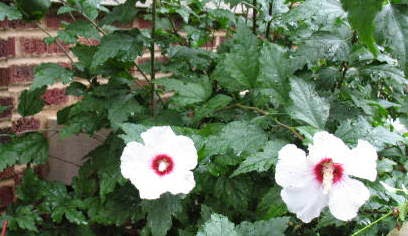
Hibiscus syriacus

     As we pass from summer into Autumn, we can also move from our Bottlebrush Buckeye to the hibiscus family, who tend to bloom from late summer until first frost. The hibiscus family contains under one roof a confusing variety of plants and an even greater variety of names. It's members range from 12 foot woody shrubs to knee-high perennials and have many aliases: Althea, Mallow, Rose  Mallow, Swamp Rose and Rose of Sharon.


     The largest of these, Hibiscus syriacus, is usually known as Rose of Sharon or Althea. Once thought of as old fashioned, Rose  of Sharon are actually appropriate for many houses in our area of Chicago and have experienced a revival in popularity. Although they can get to be 12 feet tall, they bloom on new wood, so you can prune them ferociously in late winter and  still have a substantial and floriferous shrub by summer.


Texas Star Hibiscus


     The other cultivars of hibiscus are far less common  in Chicago yards and we are missing out. Ranging from three to seven feet tall, many die down to the ground every winter. In their prime they produce huge disks in vibrant colors that  can give our yards a tropical flavor.


Hibiscus moscheutos

A PS on the Bottlebrush Buckeye:  The owner of the shrub in my last posting pointed out that his Buckeye also  attracts exotic butterflies. Yet another virtue possessed  by one of my favorite plants.

Sunday, August 24, 2014

AESCULUS PARVIFLORA

Aesculus to the right.
     Periodically I make an effort to encourage biodiversity by highlighting an underused native plant. Since native plants seldom get the respect they deserve, I gussied this one up with its Latin title. "Aesculus"  even sounds vaguely like  the ancient Greek playwright. Much more elegant than "bottlebrush buckeye." Or how about horse chestnut? Or the British "conkers?"

    An impressive and elegant plant, the bottlebrush buckeye can get 8 feet high and wide in Chicago.  Generally a slow grower, it also produces new shoots from the ground that can grow a few feet in a single year. If you like the location of a shoot, let it grow. If you don't, cut it off at the ground. No rush. This is a very low maintenance plant. No serious diseases or insect problems; adapts to different soils; at home in both sun and shade. The established stems do not need pruning, but can easily be trimmed to stay at the size you want.

     As an added bonus,  very few weeds try to grow under the canopy of these buckeyes. The reason for this is a mystery, but welcome nonetheless.

These flowers are in the early stage of bloom.

     The leaves and leaf clusters have an almost tropical look. The mid-summer flowers are outstanding, and even the seed capsules are quite striking. (In Chicago fruiting is sparse, so there is almost no mess.) Buckeyes can be used as specimen plants or planted in masses -- under shade trees, for example.


     You are not just doing our native flora a favor when you give a home to this magnificent plant; you are doing yourself a favor as well.
   

Wednesday, August 13, 2014

Year of the Polar Vortex

Chicago Beachwear in July.


     First an apology for my long absence. My clients simply overwhelmed me with work. I could just see the reaction from some of them  to a post from me: "So the guy hasn't found time to do my job yet, but he has time to scribble." First things first.

     Yesterday at 3 PM my thermometer read 61 degrees -- more than 20 degrees lower than the average high for that day. This continues a trend that began with our ferociously cold winter that led to a cold and wet spring. Spring in turn spawned the coldest July on record.

    The coldest July on record sure beats the coldest January on record, and I, for one, was a happy camper -- unlike Chicago beach goers,who had to deal with frigid water temperatures as well as cool air.

     The response of our plants has been mixed. The winter created some real damage this year. Roses had to be trimmed much lower this spring and  many yews  were covered with brown tips from winter dessication. Our insect pests like Japanese beetles, declined in number. But some of the hearty fungal spores enjoyed the wet spring and attacked plants they had left alone previously -- -like my broccoli.

This year's invalid broccoli..

     I had a beautiful patch of basil this year. Just before we planned to harvest half of it to make pesto for the winter, an absurd "polar vortex" blew in and blackened most of our basil leaves-- in July! We had to cut the top  3/4 of each plant and then wait for them to re-grow.

     Fortunately, though, most  plants in the area were just held back a couple of weeks. Most  flowers and veggies are now thriving,  and we have planted seeds for a fall crop in our garden. After three cold seasons in a row, maybe we will get a break this fall.


Tuesday, May 27, 2014

Bloom Time!


     It is now peak bloom time and also peak planting time, so I hope to be forgiven for falling behind. We have planted this near the front door and the fragrance is a joy  to experience  as we go in and out of the house.

     Those of us who love fragrance can extend our season by many weeks by picking our plants -- either other lilacs or other species. I have been waiting for some years now for a client who wants to maximize his or her olfactory experience. Any takers?

     Lilacs should be pruned as soon as the bloom fades. Prune once and prune hard. Any snipping you do later will just cut off the buds for next year.


     And now we get to the most spectacular  flower in the US, the tree peony (Paeonia suffricosa). This shrub does not flop, and unlike herbaceous peonies, does not attract ants as much as its herbaceous cousins. Its bloom is nothing short of awesome.


     The shrub form of the peony also blooms a few week earlier than the herbaceous varieties, so you can extend your season. These flowers come in an endless variety of colors  as well.


     I spend a lot of time on vegetables last year, so I am giving you a break this year. My warm weather veggies (tomatoes, cukes, peppers,etc.) were planted over Memorial Day weekend. My North Carolina friends, who are already harvesting tomatoes, are having a good laugh at my expense.


Sunday, May 4, 2014

Forsythia Redux


Hi --A reader sent me this after my last post. Scott


Scott,
Forsythia inspired Robert Frost to write this:


Nature’s First Gold is Green

Nature’s first green is gold
Her hardest hue to hold
Her first leaf’s a flower
But only so an hour
Then leaf subsides to leaf
So Eden sank to grief
So dawn goes down to day
Nothing gold can stay.