Friday, October 9, 2015

Blooms in Early Fall


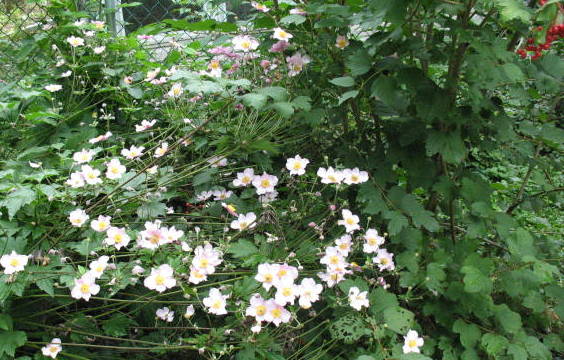
     Labor Day does not end the season in our flower gardens unless we want it to. One example is the Japanese anemone pictured here. My anemones began to bloom in August and,  while largely over now, are still giving me new blossoms today.

     A very large and irrepressible perennial, Japanese anemone can take up a huge amount of real estate. If you don't want to spend a lot of time staking and pruning it, it is best put it toward the back or in another spot where you will  not expect it to be neat and tidy.

     Other summer/fall plants that shine this time of year are hydrangeas. We adopted this Limelight Hydrangea a few years ago. My Wife Wan is in this photo (under protest) to give  you a sense of scale.
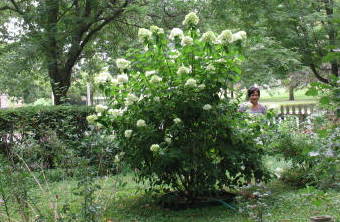


     These Hydrangeas start with a "limelight" cast to them, then turn snowy white, and eventually add some pink tones as well.

     Autumn Clematis is also in its prime in September and is still attractive in October. A client in Hyde Park has  a "ruin" of an old wood play set that has been completely taken over by Clematis (with a little help from us.) I showed a photo of it a couple of years ago on this blog.

     This spring I borrowed a cutting from the Hyde Park plant to start on my front arbor.


     This vine is aggressive, but not difficult to handle. Next year I will have to cut a hole above the walk to allow the mailman in. But you could not ask for a more enticing entry to my front yard.

    The champion of fall bloomers, though, is the Knock-Out Rose. As  long as you snip off the spent flowers it will continue to  produce -- seemingly forever.


     This photo was taken today, and these flowers will continue to look good in mid-November. In a good year some will make it past Thanksgiving.  In Chicago that is indeed something for which to be thankful.

Friday, September 18, 2015

Harvest


Summer Basil with Broccoli Looming Behind


     After a very cold and wet spring that lasted through June, my warm weather crops were really plodding. Leafy vegetables like Swiss Chard and Basil responded quickly to a little hot weather. But my tomatoes, cukes and green beans grew lots of leaves and stalks but refused to flower or fruit through all of July and part of August.Only my chili peppers began to fruit in July

     My cukes relented first toward the end of July. We grow the pickle type that does not need peeling. They had a great August and are just finishing up now. 

Hiding under a Leaf.

     We dug up half our crop of fingerling potatoes in August and just dug the last half up last weekend. These little guys melt in your mouth and are very easy to grow.

     Tomatoes always seem to involve a roll of the dice, and we usually plant about six varieties to increase our chances. August began with only our cherry and grape tomatoes that are still producing today. Larger ones followed -- very slowly. We have always had a basket full  in the kitchen, but we kept up with them fast enough that we have not been able to freeze any.


A large Tomato Peeks out.

     Our most prolific plants are the grape tomatoes that we have to pick up off the ground every morning.

Overnight Harvest

     Our 'Early Girl' tomatoes, which are bred to mature early in the season, are just now going great guns after goofing off all  August. This season as a whole has not been a terribly prolific one. But what does show up is amazingly sweet and delicious -- far better than even the local farmers' market.

     And we are far from done. We continue to harvest broccoli, Swiss chard, parsley and basil every other day. And our new fall crop of snow and sugar snap peas is just now starting to flower. We will still be eating these well past the first several frosts.

Snow Peas Blooming


Sunday, August 30, 2015

Hibiscus


          We are nearing the end of the dog days of summer -- a time during which only the prospect of a delicious garden tomato can push me outdoors voluntarily. Yet some of our prettiest flowers bloom in August. We can consider them our reward for planting we did earlier.

     Today I want to show off two quite different forms of hibiscus, both of which bloom in August and September.

     The first is familiar to most of us. Only the names are confusing. Known here as Rose of Sharon and in Britain as Rose mallow, even its Latin name  is confusing. Linnaeus, the founder  of modern taxonomy, called it Hibiscus syriacus, but it has no connection to Syria. It also has no connection to the plain of Sharon in Israel. In fact, the name first appears as a mistranslation in the King James Bible. Hibiscus syriacus is the national flower of South Korea and has been cultivated there for generations.


     Besides its white to red to purple blooms, the Rose of Sharon has many other virtues for the Chicago garden: it is not picky about soil pH; it tolerates a fair amount of shade; it can get by in all but very wet and very dry soil. It is an upright shrub that  can reach 8-12 feet high while only 6-9 feet wide. And it is easy to prune in early spring  when the weather is cool and you have nothing better to do.

     The other hibiscus hardy enough to grow here has the virtue of agreement in the English speaking world on its name. Both the US and the UK call it rose mallow.  It is also called  hardy hibiscus to distinguish it from its many tropical cousins.  In Latin confusion reigns over many sub-species, but most plant are bought as commercial hybrids, so we don't care.


          My rose mallows are now about three high and may get a little higher, but there are others that can get up to 6 feet with flowers as big as dinner plates. Perennial hibiscus, too, are  tolerant of most conditions we face in Chicago. If your yard has a bit of the blah's in these dog days of summer a few hibiscus may be just what you  need.

Sunday, August 16, 2015

Beverly's New Guest

Smooth Leaves


     After our very wet spring and early summer we have accumulated a number of pests -- from slugs and scale to various sorts of fungus. By the end of July, however, I was getting reports of of a new "guest", one I had not seen in a long time --- poison ivy. Once a "country cousin" not seen much outside of metro-parks, poison ivy has begun to be seen more and more in golf courses. And now it has made an unwelcome appearance in Beverly yards.

     A rather anonymous plant, poison ivy is usually recognized by one's skin before one's eyes. It has three leaflets, but these can be of several shapes -- from smooth to serrated to deeply notched. Sometimes all three leaf shapes can appear on the same plant.  It develops whitish berries -- except when it doesn't. Sometimes its stems are red -- and sometimes they aren't.

Notched leaves

     Poison ivy can grow like a shrub -- but it also can grow like a vine -- up a tree trunk and out to smack you in the face when you are looking for it on the ground. The berries produce seeds which the birds spread around, but the plant also spreads through underground stems.


Vine Form
     In addition to being sneaky poison ivy is also very hard to kill. If you try to pull it out, the pieces remaining in the ground will regenerate. Burning it creates a vapor that gets in your eyes and lungs and makes you wish you had it only on your skin.

     The only real solution is to poison it, which may take repeat spraying. The leaves eventually turn white and die, but even then they are toxic, so use gloves and long clothing any time you approach it. Seal up the remains before disposing of it.

Monday, July 13, 2015

Midwest Monsoon


     June in Chicago was not only colder than normal; it was also the wettest June since records began to be kept in 1895. July has been a bit warmer but the rains continue on and on.

    Our Midwest monsoon has altered what is happening in the garden.


     In our vegetable garden our cool weather crops like spinach and parsley practically took over. Our snow peas are still producing a pound a day of pea pods. In previous years they would be withering by now. Warm weather crops, though, like cukes and tomatoes, did next to nothing all June.

     Our pest problems have changed this year as well. I have had some normally hardy shrubs in low-lying spots that literally drowned this spring. As you might guess,  powdery mildew has become more of a problem than usual, as have other fungal diseases, and it is no surprise that slugs are having a great time. Scale launched a big attack on a well established magnolia for the first time this year. Nothing is quite normal and it behooves  us to inspect even previously healthy plants.

     Iris loved this spring for some reason.


     Knock-Out roses -- usually the hardiest variety in the rose family, had a rough time of it this spring and are only now recovering, while their usually more delicate cousins had a banner year. We just started this climbing rose late last fall.


          Our Jackmanii clematis and Asiatic lilies have also liked the season so far.


     Finally, the wet season resulted in a flood of work for me and my crew. We have still not caught up. And that is my excuse for being so tardy with this post. At  least the dog did not eat my homework.

Saturday, June 13, 2015

Peonies


     This is the month of the peony -- the show off plant of late spring. Peonies are to perennials what tulips are to bulbs. In bloom they are spectacular, but they are also a royal pain.

      The two  major complaints about herbaceous peonies are that ants love them more than we do,so we have to  be careful bringing them inside. Secondly, they flop. A rainstorm occurs like fate shortly after the flowers are in their glory and the next morning all of them are in the mud.


      But who can resist the appeal of my neighbor's house when his peonies are in their glory.

     To have any hope of your herbaceous peonies lasting past the first rain, you have to support them and there are plenty of alternatives available in most garden centers.

     But the ultimate answer is planting tree peonies. An expensive relative of the herbaceous peony, these shrubs, because of their woody stems, do not flop. And they have some of the most spectacular blooms anywhere.


      If you are passionate about peonies, you can extend their season by picking different cultivars. But start by adding a few tree peonies. In addition to their other virtues, they also bloom at a different time than their herbaceous cousins.


Wednesday, May 13, 2015

Tulips


     By now the warm up acts are beginning to leave the stage. Time for the tulips to make their appearance. Tulips are indeed the prima donnas of the bulb world. Their size and variety and the intensity of their colors are unequaled. But like the diva's in the opera world, they can be a lot of trouble.


          For one thing, not all of their fans are human. Squirrels  love tulip bulbs, especially newly planted ones. It is usually a good idea to stake some netting or wire mesh over your tulip  bed during its first year. Just leave it there until the first  shoots come up in spring.


     Tulips also demand a lot  of food. I personally do not molly-coddle my flowers, so the ones you see here  are survivors. But it is not unusual to find half  the bulbs in a bed not flowering three years after they were planted. Those trying to plant full, formal beds usually end up planting tulips as annuals rather fertilizing over and over.


          Once the show is over tulips leave quite a mess. At one time or another most of us have tried to snip off the leaves once the bloom  was done only to discover that  we had no flowers the following year. That ugly mess of leaves is still gathering sunlight and restoring the bulb  below ground. It cannot be removed without injuring the plant. Traditionally tulip leaves  were braided for the rest of the season. Try that once. I bet you won't do it again.


     The easiest way to deal with ugly leaves is to hide them behind something else. If you plan your bulbs to grow behind a nice perennial like a hosta, the tulip will have the stage to itself early in the season and then be able to hide behind its cousin as it tries to prepare itself for next year.

     For this week, though, our only duty is to enjoy them in their splendor.